
Hair Restoration Timeline: What to Expect Month by Month
A realistic hair restoration timeline is measured in months, not days. Whether your plan includes PRP therapy, cold laser hair therapy, FUE hair transplant planning, supportive medications, or a combination approach, the process usually starts with evaluation and scalp health first. Visible change often follows gradually as shedding slows, follicle activity improves, and new growth has time to mature.
Ready to understand which timeline fits your hair loss pattern? Book a hair restoration consultation with VidaVital Medical for a physician-supervised evaluation and personalized treatment plan.
This guide explains how long hair restoration can take month by month, what is normal during early shedding, when many patients begin to notice visible changes, and why follow-up care matters. Individual outcomes vary based on age, genetics, hormone balance, scalp health, treatment type, medication use, consistency, and how early hair loss is addressed.
Quick Answer: How Long Does Hair Restoration Take?
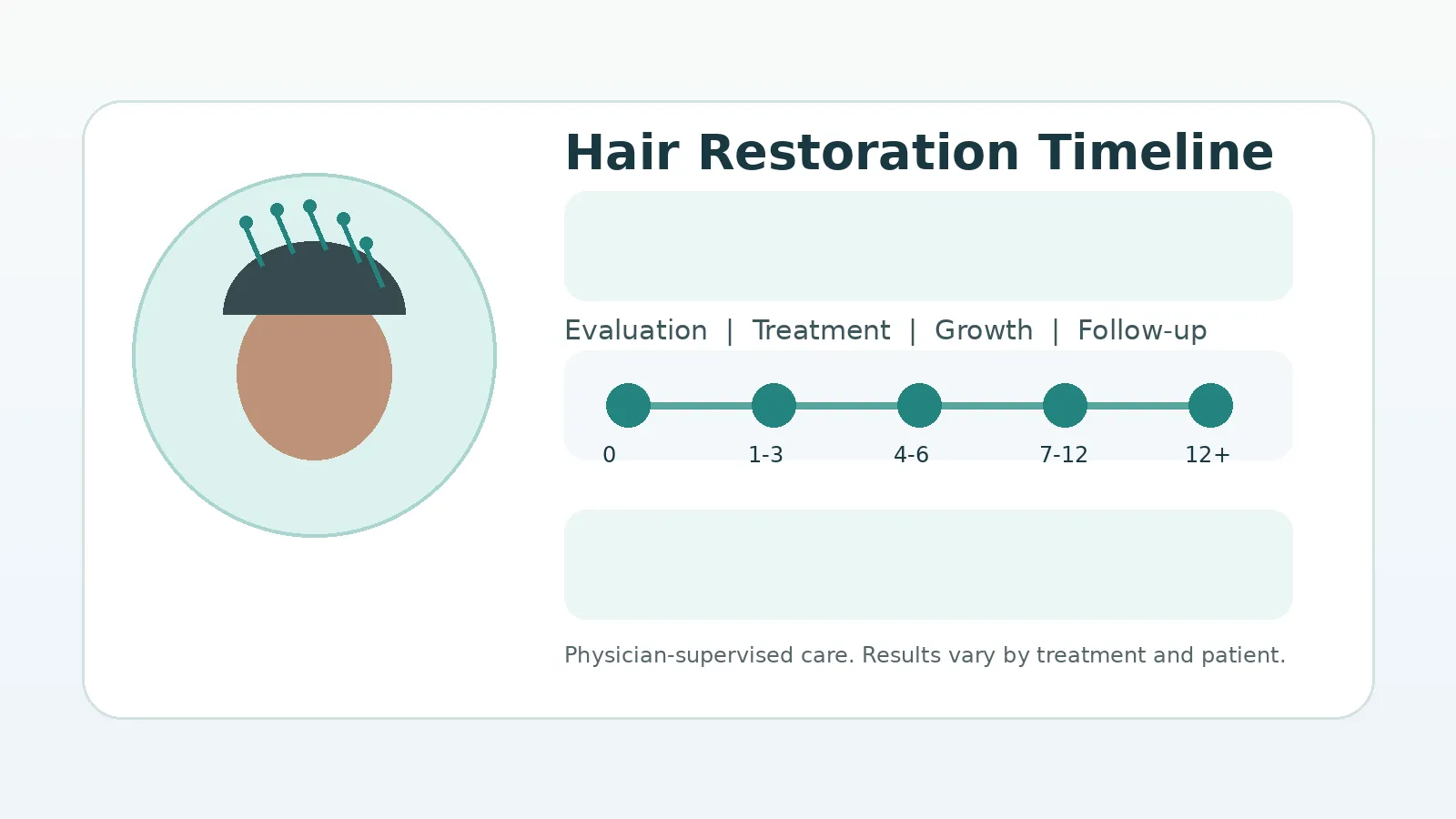
Most non-surgical hair restoration plans take at least three to six months before visible improvement becomes noticeable. Hair transplant results often unfold over 12 to 18 months because transplanted follicles need time to shed, rest, regrow, and mature. PRP and cold laser therapy may support healthier-looking hair earlier for some patients, but the best results still require patience and consistent follow-up.
| Timeline | What may happen | What to remember |
|---|---|---|
| Weeks 0 to 4 | Evaluation, treatment planning, first sessions, scalp adjustment | This is the setup phase, not the final-result phase |
| Months 1 to 3 | Possible shedding, early scalp health changes, consistency building | Temporary shedding can be part of the process |
| Months 3 to 6 | Early visible change for some patients, reduced shedding, texture improvement | Progress may be subtle at first |
| Months 6 to 12 | Density, coverage, and hair quality may continue to improve | Follow-up helps refine the plan |
| Months 12 to 18 | Transplant maturation or long-term maintenance phase | Some results continue maturing beyond one year |
Before Month 1: Evaluation and Treatment Planning
The first step is not the procedure. It is understanding why hair loss is happening. A strong plan begins with a clinical evaluation of your hair loss pattern, scalp condition, medical history, medications, stress, nutrition, family history, and hormone-related symptoms. For some patients, hair thinning is mainly genetic. For others, it may be influenced by hormonal shifts, thyroid concerns, nutrient status, inflammation, recent illness, weight changes, or lifestyle stress.
At VidaVital Medical, hair restoration is physician-supervised and may include options such as PRP therapy for hair regrowth, cold laser hair therapy, and FUE hair transplant planning. The right option depends on whether the goal is to slow shedding, improve hair quality, support early thinning, or address more advanced areas of loss.
This evaluation phase also sets expectations. Patients with early to moderate thinning may respond differently than patients with long-standing hairline recession or significant crown loss. A personalized plan may include staged treatment, baseline photos, lab review, scalp care recommendations, and scheduled follow-ups so progress can be measured over time.
Month 1: Treatment Starts and the Scalp Adjusts
During the first month, the main goal is to begin treatment consistently. If PRP is part of the plan, the visit usually involves drawing a small amount of blood, processing it to concentrate platelets, and placing the platelet-rich plasma into targeted scalp areas. PRP is designed to use the body’s own growth-factor activity to support follicle function and scalp circulation.
If cold laser therapy is part of the plan, the first month is about building routine. Low-level laser therapy uses red light energy to support cellular activity in the scalp. Some patients use in-office treatments, while others may use an FDA-cleared laser cap as recommended by their provider.
If FUE transplant planning is appropriate, month one may involve mapping the hairline, evaluating donor density, reviewing goals, discussing recovery, and deciding whether supportive therapies should be used before or after the procedure. FUE is more involved than PRP or laser therapy, so planning is a major part of the timeline.
Months 1 to 3: Why Shedding Can Happen Before Growth
One of the most important parts of the hair restoration timeline is understanding early shedding. Some patients worry when they notice more shedding after starting treatment. In many cases, temporary shedding can happen as follicles shift through the hair growth cycle. It does not automatically mean treatment is failing.
Hair naturally moves through growth, transition, resting, and shedding phases. Restoration treatments aim to support healthier follicle activity, but hair biology still takes time. New hair does not appear overnight because follicles need time to respond, reset, and produce visible strands.
This is also the phase where consistency matters most. Missing sessions, stopping supportive care too early, or judging the plan after only a few weeks can lead to frustration. Your provider may use photos and follow-up questions to determine whether shedding is within an expected range or whether the plan should be adjusted.
Months 3 to 4: Early Changes May Become Noticeable
For some patients, months three and four are when early changes begin to show. These may include less shedding in the shower, improved hair texture, more scalp coverage in certain lighting, or fine new growth in treated areas. These changes can be subtle, especially at first.
PRP patients may be partway through a recommended series by this point. VidaVital’s hair restoration services commonly include a consultation-based plan, and PRP packages may be recommended when a series is appropriate. Patients considering local care can learn more about hair restoration in Boca Raton or hair restoration in Coral Gables depending on which clinic is more convenient.
It is normal for progress to look uneven at this stage. The crown may respond differently than the hairline. Thinning related to stress or nutrition may behave differently than genetic thinning. Men and women may also have different patterns of loss, which is why a customized plan matters.
Months 4 to 6: Visible Improvement Often Builds Gradually
Many patients who respond to treatment begin to see more meaningful changes between months four and six. Hair may look fuller, shedding may be less noticeable, and treated areas may appear healthier. This does not mean the final result has arrived. It means the plan may be moving into the visible-progress phase.
For PRP therapy, this window often follows multiple treatment sessions. For cold laser therapy, it reflects consistent use over time. For patients who have had an FUE transplant, early regrowth may begin to appear, but the new hairs can be fine, light, or uneven before they mature.
Midway through your restoration journey is the right time to reassess. If you are seeing early change or if progress feels unclear, schedule a follow-up with VidaVital Medical to review photos, treatment consistency, and next steps.
Months 6 to 9: Density and Hair Quality May Continue Improving
Months six to nine are often when patients become more confident about the direction of their results. Hair density may improve, the scalp may be less visible in treated areas, and hair texture may feel stronger. If a transplant was performed, the hairline or treated region may look more defined, although the result is still maturing.
This is also when your provider may discuss maintenance. Hair restoration is not always a one-time event because untreated follicles can continue thinning over time. Maintenance may include additional PRP sessions, laser therapy, medication review, scalp health support, hormone evaluation when appropriate, or changes to your home routine.
For patients comparing options and costs, VidaVital provides general pricing context on its men’s health clinic cost page, including listed PRP hair restoration pricing. Final recommendations and pricing can vary based on the plan, the number of sessions, and whether more advanced restoration is needed.
Months 9 to 12: Results Become Easier to Judge
By months nine to twelve, many patients have a clearer sense of how well the plan is working. Non-surgical treatments may show improvements in shedding, thickness, and overall coverage. Transplant patients may see a more developed result, although crown areas can continue maturing more slowly than the front hairline.
This stage is useful for comparing baseline photos with current photos. Bathroom lighting and daily styling can make progress hard to judge, so consistent photos from the same angles are important. Your provider may look at density, coverage, hair caliber, ongoing shedding, scalp condition, and whether the original goals still match your response.
If progress is strong, the next step may be maintenance. If progress is limited, the plan may need to be adjusted. That might include a different treatment schedule, additional testing, medication discussion, or reviewing whether FUE transplant planning makes sense for areas that are less likely to respond to non-surgical care.
Months 12 to 18: Long-Term Maturation and Maintenance
For transplant patients, the 12 to 18 month window is often when the result continues to refine. Hairs may thicken, blend better with surrounding hair, and settle into a more natural appearance. For PRP or laser patients, this phase is more about protecting the progress made and deciding on a maintenance schedule.
Maintenance is personal. Some patients need periodic treatment to support ongoing follicle health. Others may need a broader wellness review if hair loss is connected to hormones, metabolic health, stress, or other internal factors. VidaVital’s model combines wellness medicine with regenerative options, which can be helpful when hair loss is part of a larger health picture.
The key is not to disappear after the initial series. Hair restoration works best when the plan is monitored, adjusted, and connected to the reason hair loss started in the first place.
What Affects Your Hair Restoration Timeline?
No two timelines are identical. Several factors can speed up, slow down, or limit visible results:
- Stage of hair loss: Early thinning often has more active follicles to support than long-standing bald areas.
- Treatment type: PRP, laser therapy, supportive medications, and FUE transplant have different timelines.
- Consistency: Missed sessions or inconsistent at-home therapy can reduce momentum.
- Hormone and metabolic health: Thyroid function, testosterone balance, menopause, insulin resistance, and nutrient status may influence hair quality.
- Genetics: Family history can affect the pattern and pace of thinning.
- Scalp health: Inflammation, irritation, dandruff, or poor circulation may need attention.
- Stress and recovery: Illness, rapid weight loss, surgery, and major stress can trigger shedding events.
This is why the best answer to “how long does hair restoration take” is not a single number. A more accurate answer is that the timeline depends on diagnosis, treatment choice, and follow-through.
How to Track Progress Without Overreacting
Hair changes slowly, and daily mirror checks can make progress feel invisible. A better approach is to track results in a structured way.
- Take baseline photos before treatment starts.
- Use the same lighting, angles, distance, and hairstyle each month.
- Track shedding trends, not individual hairs.
- Keep follow-up appointments even if early results are subtle.
- Tell your provider about medication changes, illness, stress, or major weight loss.
- Avoid comparing your timeline to another patient’s result.
Progress should be reviewed clinically, not emotionally. A temporary shedding phase, a slow month, or uneven early growth does not always mean the plan is failing. It may simply mean the hair cycle needs more time.
When Should You Call Your Provider?
Contact your provider if shedding feels sudden or severe, the scalp becomes painful or irritated, you develop signs of infection after a procedure, or you are unsure whether your response is expected. You should also check in if you are considering stopping treatment because early progress feels slow.
Patients should also be honest about goals. If you want a major hairline change, a non-surgical plan may not be enough. If you want to slow thinning and improve hair quality, PRP or laser therapy may fit better. The right conversation saves time and helps align treatment with realistic outcomes.
Common Questions About the Hair Restoration Timeline
Can hair restoration work in one month?
Visible new growth in one month is uncommon. The first month is usually focused on evaluation, treatment initiation, scalp response, and setting the foundation for future growth.
Is shedding after PRP or a transplant normal?
Some shedding can occur as follicles move through the hair cycle or after a transplant. Your provider can help determine whether the amount and timing of shedding fit the expected pattern.
When will I know if treatment is working?
Many patients need at least three to six months before judging early response. Transplant results often require 12 months or longer to evaluate fully.
Do I need maintenance after results appear?
Many patients benefit from maintenance, especially when genetic thinning or hormonal factors are involved. Maintenance plans vary by patient and treatment type.
The Bottom Line
A realistic hair restoration timeline starts with diagnosis, not guesswork. The first month is usually planning and treatment initiation. Months one to three can include shedding and adjustment. Months three to six may bring early visible change. Months six to twelve often show clearer density and coverage. For FUE transplant patients, maturation can continue into months twelve to eighteen.
If you are ready for a personalized timeline, VidaVital Medical can help you understand your options. Schedule a physician-supervised hair restoration consultation to review your hair loss pattern, treatment options, and realistic next steps.