
Weight loss medications have helped thousands of people across Las Vegas and Southern Nevada achieve results when other approaches fell short. But for many patients, the story follows a familiar pattern:
"It worked incredibly well at first… and then it just stopped."
If that sounds like your experience, take a deep breath. You're not broken, and the medication didn't necessarily fail. In most cases, your body simply adapted: and your treatment plan needs to evolve with it.
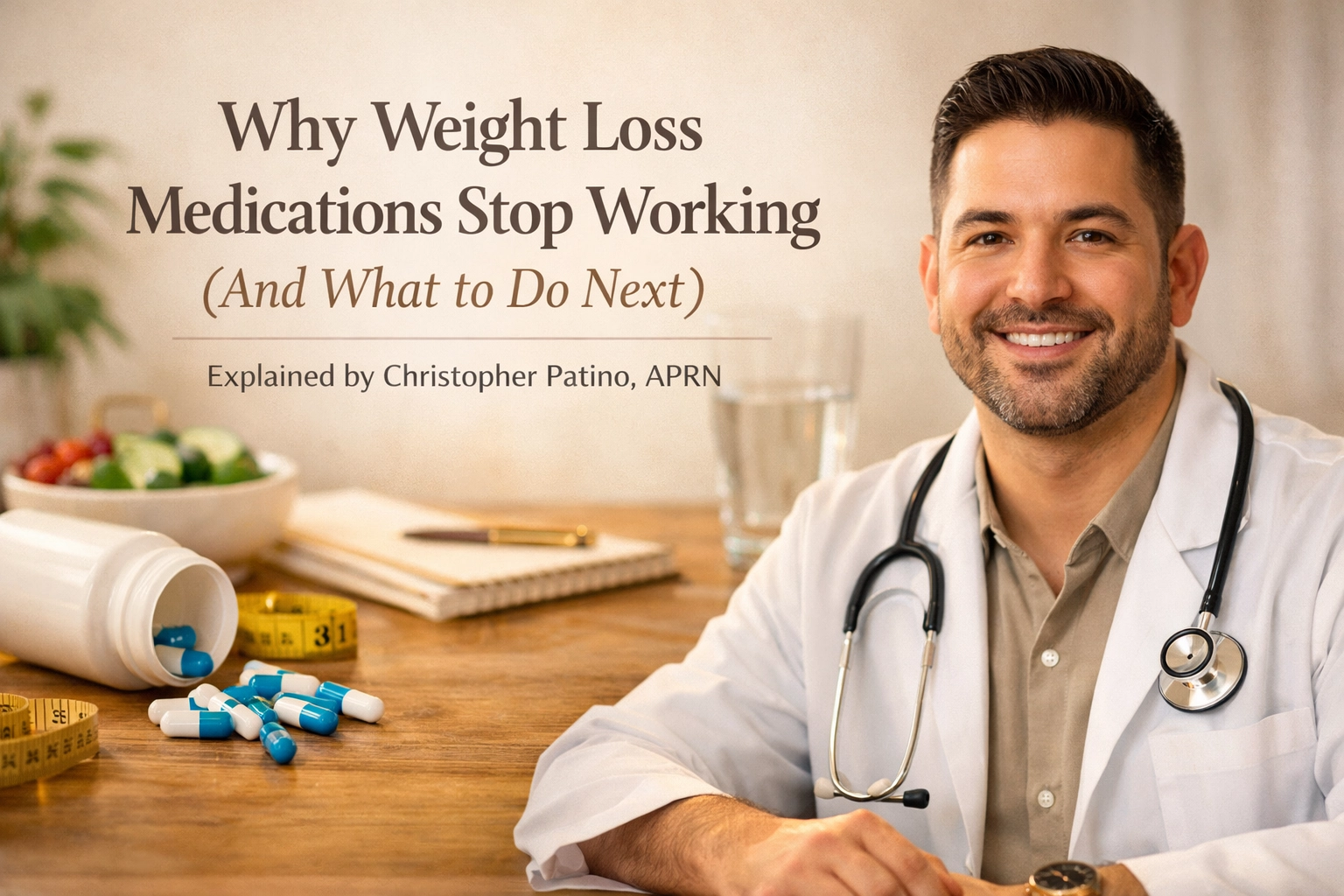
In this provider-led discussion, Christopher Patino, APRN of VidaVital Medical explains why weight loss medications like semaglutide and tirzepatide often lose effectiveness over time, and more importantly, what needs to change for progress to continue safely and sustainably.
🎥 Watch the Full Provider Explanation
Before we dive deeper, hear directly from Christopher Patino, APRN as he walks through the science and clinical solutions:
Why Weight Loss Gets Harder Over Time
The human body is a survival machine. When you begin losing weight, your body doesn't interpret that change as progress: it sees it as a potential threat. This triggers a cascade of protective biological responses designed to conserve energy and prevent further loss.
These responses are not failures of willpower. They are normal, predictable physiological adaptations that include:
- A slower metabolic rate : Your body burns fewer calories at rest as you lose weight
- Increased hunger and appetite signaling : Hormones like ghrelin rise, making you feel hungrier
- Reduced energy expenditure : You naturally move less and burn fewer calories throughout the day
- Greater efficiency at storing fat : Your body becomes better at holding onto energy reserves
This isn't your body sabotaging you. It's doing exactly what it evolved to do: protect you from perceived starvation. Understanding this removes the shame and helps you see that the solution isn't "trying harder": it's working smarter with medical guidance.

Why Weight Loss Medications Work at First
Medications like semaglutide (Ozempic, Wegovy) and tirzepatide (Mounjaro, Zepbound) are effective early on because they help regulate appetite, blood sugar, and food intake through multiple mechanisms. Many patients experience rapid initial results that feel almost effortless.
However, these medications don't operate in isolation. They're tools that work with your body: not magic bullets that work despite it. As your weight decreases and your body begins adapting, the medication's impact can diminish unless the overall treatment plan evolves alongside those changes.
This is a critical point: the medication didn't stop working: your body's needs changed.
Why Medications Alone Are Not Enough
Weight loss medications are powerful tools, but they are not permanent fixes. They cannot replace or restore:
- Metabolic health : How efficiently your body processes and uses energy
- Hormonal balance : The delicate interplay of thyroid, cortisol, insulin, and sex hormones
- Muscle mass : The metabolically active tissue that drives calorie burn
- Sleep quality : The foundation of hormonal regulation and recovery
- Stress regulation : Chronic stress elevates cortisol, which promotes fat storage
If these underlying systems aren't addressed alongside medication, progress frequently stalls: not because you failed, but because the treatment wasn't comprehensive enough.
This is why patients who rely solely on medication without medical oversight or strategic adjustments often hit frustrating plateaus that feel impossible to break through.
Common Reasons Weight Loss Medications Stop Working
When weight loss slows or stops entirely, it's typically due to one or more of the following factors:
Metabolic Adaptation
As you lose weight, your body becomes more efficient, requiring fewer calories to function. This metabolic slowdown is a normal response but means your earlier calorie intake and medication dose may no longer create the same results.
Loss of Lean Muscle Mass
Rapid weight loss without adequate metabolic support: especially protein intake and resistance training: can lead to muscle loss. Since muscle tissue burns more calories than fat, losing muscle further slows your metabolism.
Hormonal Changes
Weight loss affects hormones involved in appetite regulation (leptin, ghrelin), energy balance (thyroid hormones), and fat storage (insulin, cortisol). Women going through perimenopause or menopause face additional hormonal shifts that can interfere with progress.
Lack of Treatment Adjustment
Many weight loss programs keep patients on the same medication and dose for months without reassessment. But your body doesn't respond on a fixed timeline. Without adjustments based on labs, body composition, and symptoms, results plateau.
Stress and Poor Sleep
Chronic stress and inadequate sleep increase cortisol levels, which promote abdominal fat storage and interfere with fat loss. Research shows that sleep deprivation also disrupts appetite-regulating hormones, making it harder to maintain progress.
Medication Adherence Issues
Inconsistent dosing: taking medications at irregular times, missing doses, or frequently changing your schedule: can cause unpredictable results. Studies show that long-term, consistent use is essential; patients who stop treatment often regain two-thirds of lost weight within a year.
Without clinical reassessment and adjustment, these factors compound over time, making it feel like you're doing everything right but still stuck.
Why One-Size-Fits-All Weight Loss Plans Fail
Here's an uncomfortable truth: some programs keep patients on the same medication and dose for months or even years without meaningful evaluation or adjustment. But the body doesn't respond according to a preset schedule.
Effective medical weight loss must adapt based on:
- Updated lab work and metabolic markers
- Body composition changes (muscle vs. fat loss)
- Hormonal shifts and thyroid function
- Individual metabolic response and symptoms
- Ongoing patient feedback and experience
When treatment doesn't evolve, care becomes reactive instead of proactive: and your results suffer. You deserve better than a cookie-cutter approach.
What to Do When Progress Stalls
When your weight loss medication stops delivering results, the answer is rarely "just increase the dose." A smarter, safer approach begins with comprehensive reassessment:
Medical evaluation should include:
- Updated comprehensive lab work
- Review of hormonal and metabolic markers (thyroid, insulin, cortisol)
- Evaluation of muscle mass versus fat loss
- Nutritional assessment and protein intake review
- Recovery factors: stress levels, sleep quality, hydration
- Medication interactions and adherence patterns
From there, your treatment plan can be thoughtfully adjusted to support metabolism, preserve lean muscle, and restore progress safely: not just chase a number on the scale.
What Medically Guided Weight Loss Looks Like at VidaVital Medical
At VidaVital Medical, we approach weight loss medically and metabolically: not just cosmetically. This means treating the whole person, not just prescribing medication and hoping for the best.
Our approach includes:
- Comprehensive evaluation before treatment begins : Understanding your unique metabolic baseline, hormone levels, and health history
- Ongoing monitoring and reassessment : Regular check-ins and lab work to track how your body responds
- Strategic adjustments based on data : Modifying treatment as your body changes, not waiting until you hit a wall
- Focus on long-term metabolic health : Building sustainable habits, preserving muscle, and optimizing hormones: not just rapid weight loss at any cost
The goal isn't just to help you lose weight. It's to help you achieve sustainable improvement in your metabolic health, body composition, energy levels, and overall quality of life.
Why Medical Oversight Makes the Difference
Weight loss medications affect multiple systems in your body: hormones, metabolism, appetite regulation, blood sugar, and more. Without proper medical monitoring, patients often experience:
- Plateaus that could have been identified and prevented
- Loss of lean muscle mass that slows metabolism further
- Hormonal imbalances that undermine progress
- Metabolic slowdown that makes weight maintenance difficult
- Side effects that go unaddressed and lead to discontinuation
With provider oversight from licensed medical professionals like those at VidaVital Medical, these issues can often be identified early and addressed before they become long-term obstacles. Research shows that about 15% of patients won't respond to GLP-1 medications at all, while others need dosage adjustments, combination therapies, or additional metabolic support.
You're not meant to navigate this alone. Medical weight loss is medical: and it requires medical expertise.
You're Not Failing: Your Plan Needs to Evolve
If your weight loss medication worked at first and then stalled, it doesn't mean you've done anything wrong. It means your body adapted: and your treatment plan needs to evolve with it.
Weight loss isn't about pushing harder through sheer willpower.
It's about understanding your metabolism, addressing root causes, and adjusting your treatment based on how your unique body responds.
You deserve a partner in this process: not just a prescription.
🎥 Watch Christopher Patino, APRN explain the full picture:
👉 Click here to watch
Ready to Get Unstuck?
If you're experiencing a weight loss plateau or your medications have stopped working, it's time for a different approach. At VidaVital Medical in Las Vegas, we provide concierge-style, medically supervised weight loss care that treats you as an individual: not a protocol.
Schedule your consultation today and let's build a plan that evolves with you.
About the Author
Christopher Patino, APRN is a licensed medical provider at VidaVital Medical specializing in medical weight loss, hormone optimization, and metabolic health. His approach emphasizes individualized care, evidence-based therapies, and long-term patient outcomes through clinically supervised treatments.